

Watershed Education Program
Program Information
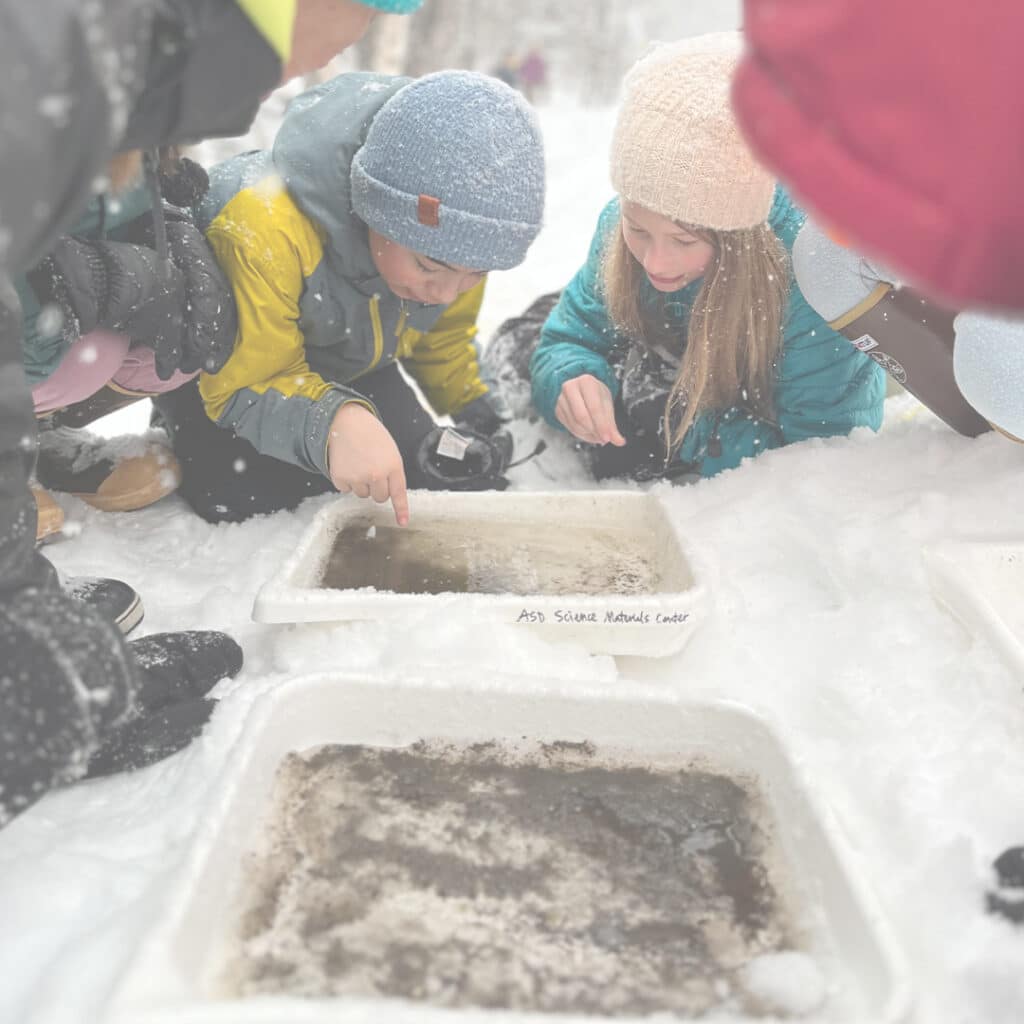
Our Watershed Education Program, designed and run in partnership with the U.S. Fish and Wildlife Service and the National Fish and Wildlife Foundation, serves 4th grade classrooms along the Chester Creek Watershed in Anchorage. This three-part outdoor education program each spring immerses students in the scientific process along their local watershed, while they collect data to answer, “can this stream support salmon?”
Interested in volunteering or want to learn more? Email education@akgeo.org
Programs like these promote STEM education and foster a deeper connection to nature. Explore this article on the Watershed Education in action.

The Watershed Education Program (WEP) is a multi-phased, hands-on exploration of Anchorage watersheds. WEP introduces students to their local watershed, and asks them to investigate whether the creek near their school can support the salmon lifecycle. Through a hands-on, outdoor approach, students act as naturalists and scientists to answer this question.
The three phases of WEP are:
- An in-classroom presentation to contextualize learning objectives, namely the elements of a watershed and the salmon lifecycle. This presentation lasts 1 and a half hours and includes playing a salmon game to illustrate the salmon life cycle and a lecture-style presentation.
- A “walk-to-creek” field trip, in which students walk to the creek nearest their school (approximately 5 to 20 minutes for schools along Chester Creek) and perform three tests to determine watershed health near their school. These include: measuring water velocity, water chemistry (pH and dissolved oxygen) and, looking for and identifying macroinvertebrates. Approximately two and a half hours.
- A ½ day field trip to Westchester Lagoon, the outlet of Chester Creek to Cook Inlet. At Westchester Lagoon, students perform three investigations, including repeating the macroinvertebrate identification and water chemistry, and identifying juvenile salmon.
Throughout all phases of the program, students fill out their ‘science notebook’ which reinforces the scientific method, data collection methods and stewardship.
In addition to the partner-facilitated version of WEP, which is offered to 12 fourth grade classrooms along Chester Creek annually, an accompanying kit has been developed with all the needed materials. Any teacher can check out the kit from the science warehouse, and find curriculum generalized to any watershed in Anchorage.
WEP is a unique opportunity to bring science to life for students of ASD. The hands-on approach, beginning in and near the classroom and ending at the ocean, connects students to their surroundings in meaningful and grounding ways. Throughout the history of the program, we have targeted Title 1 and near-Title 1 schools as program participants.
This program was developed in 2014 by the Anchorage School District in partnership with community partners including Alaska Geographic, Anchorage Park Foundation Schools-on-Trails Program, Get Outdoors Anchorage/YMCA, National Park Service – Alaska Public Lands Information Center (APLIC), UAF Cooperative Extension, U.S. Fish and Wildlife Service, and Alaska Sea Grant. For the 12 participating classrooms, community partners and the volunteers they recruit facilitate all three phases, with limited assistance from ASD’s STEM curriculum team. Many volunteers are professional scientists working in the fields of water quality, fisheries, and wildlife management.
In addition to partners and volunteers, teachers play an integral role of facilitating student engagement and providing further connections during and after WEP. Connected opportunities to explore and understand watersheds include BLM Campbell Creek Science Center’s Outdoors Week and Water Discovery Days.
Benefits to participating include engaging hands-on outdoor learning opportunities led by local professional science educators, hands-on training for teachers on how to incorporate outdoor environmental education into their classroom, a free field trip, and opportunities for deepening professional relationships with community partners. In addition, WEP programming coordinates with programs offered by Campbell Creek Science Center, and the 4th grade spring Science kit, providing students opportunities to make rich connections to their classroom STEM learning.